Showing posts with label Tokyo. Show all posts

Dec 24, 2012

Scenes from a Tokyo Subway Car

How many people do you spot in this subway car in Tokyo engaging with their electronic devices?


Close to 9 million passengers ride Tokyo’s subway system daily. But how many actually interact with one another? It got me thinking about New York City and London as well where people do their best to avoid social interaction on subways.

Do people interact on public transportation where you live or do their best to keep to themselves?

Sep 29, 2011

Mannequins From Around The World

It seems that wherever you travel most mannequins appear to have European features. Perhaps there is some worldwide monopoly on the often freakish figures, much like Monsanto has on soybeans?


This bobble headed mannequin outside a uniform shop in Dongdaemun Market in Seoul, South Korea would no doubt make some small children cry. Perhaps she is overcompensating for her headless comrades?


These androgynous mannequins in an Issey Miyake showroom in Tokyo are minimal and more chic. The fit right in Aoyama, an upscale fashion shopping district.


This feminine looking mannequin in Bur Dubai Souk in Dubai looks displeased to be wearing a gutra (head cloth) and dishdasha shirt dress traditionally worn by men in the UAE. Perhaps her male counterpart was on holiday the week I was there.

I’m contemplating starting a mannequin business that represents the cultures of the world. Naturally proper research would involve extensive travel.

Aug 22, 2011

Conveyor Belt Sushi Tokyo

Japan is a foodie county and the only one I know that combines gizmos with dining. Pictured below in Tokyo’s Shinjuku district is a conveyor belt sushi restaurant a few steps below street level.


Conveyor belt sushi, or kaiten-zushi in Japanese, is Japan’s version of fast food sushi. The conveyor belt winds its way throughout the restaurant within grasp of diners. Patrons take food from the conveyor belt as it passes by. If you look closely at the photos you can see ample condiments including big tubs of ginger on the counter.

Would the novelty of kaiten-zushi draw you in for a bite to eat?


Feb 17, 2011

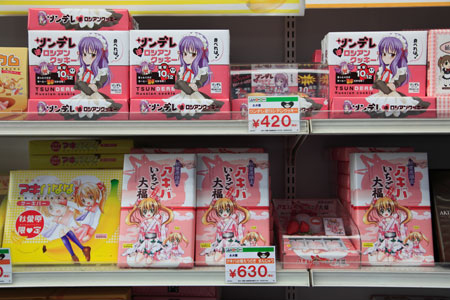
Strange Souvenirs: Edible Cosplay Treats Tokyo

Tokyo’s Maid Cafes are part of the cosplay (or costume play) culture unique to Japan. Young women dress up as maids and serve customers at the venues, which have been booming in the last several years. Patrons, who are served tea and cakes, are of often greeted with “Welcome home, Master.”


And with something popular there is often a commercial spin off of some sort. In this case it’s themed cookies and cakes.


The sweets are also available in the school girl variety.


Imagine getting caught with these in customs and trying to explain yourself.

Have you ever brought something home from your travels that might be difficult to explain to a customs official?

Previous Posts In This Series:

Barbed Wire DMZ
Mosque Alarm Clock
Ojamas

Jan 31, 2011

Bilingual Signs From Around The World

It can be humbling to be rendered illiterate when traveling in a country with an alphabet alien to your own. Street signs are meaningless and attempting to withdraw cash from an ATM with directions in Chinese characters is all but impossible for those of us accustomed to Germanic and Romance languages. I’m certainly grateful for street signs that have English translations when wandering some of the world’s cities.


In Hong Kong you’ll see many signs reminding pedestrians to look left instead of right when crossing the road. The direction of traffic in Hong Kong is a legacy of the former British Colony, where driving is on the left instead of the right. I wonder what “Mind The Gap” looks like written in Cantonese.


In Tokyo’s vast metro system girly pink signs on the platform point out which cars are reserved for women only during rush hour. They were introduced in 2005 to prevent chikan from doing what they shouldn’t do.


This sign is not in China. In fact it's located in Manhattan’s Chinatown, which borders Little Italy and its famed Mulberry Street.

When has a bilingual sign helped you from getting lost or lack of one resulted in an unplanned adventure?

Dec 21, 2010

Japan’s Don Quijote

If you need anything while in Japan you’ll find it at one of the country’s Don Quijote stores.

The discount chain offers a jumble of merchandise in its crowded, overflowing aisles. But make no mistake this is not Japan’s answer to K-Mart or the now defunct Woolworths.


There seems to be no method to the madness in terms of how things are laid out. A jumble of electronics, costumes and adult accoutrements are displayed next to socks in the same aisle.


And if you need an extra bag to pack the loot you’ve purchased this is a good place to go for inexpensive luggage. It’s also a good place to pick up novelty souvenirs and gifts. Some are open 24 hours.

Signs are in Japanese so they can be hard to spot. Look out for a blue cartoon bird which looks like the offspring of a penguin and duck.

I like to peruse the shelves of the Don Quijote located on a busy corner in Shinjuku, Tokyo. Several stories high the loot it peddles starts outside on the pavement. The top floor is dedicated to designer goods. Random one off Channel, Gucci and Fendi bags, wallets and belts are locked behind glass cases giving it a pawnshop atmosphere.

Do you have a shop where you live featuring just about everything under the sky?

Oct 23, 2010

Published Photographs: Tokyo Edition

Long after the sun goes down in Tokyo there is much to photograph. The city’s neon forests are amongst my favorite in the world. These photographs have appeared in magazines, advertisements, brochures and books.


Which cities of the world do you enjoy seeing at night as much as day?

Photographs: Top two (from left) Sukiyabashi crossing in Ginza and Shibuya. Bottom two: Shinjuku.

Mar 20, 2010

Skylines From Around The World

There are many ways to photograph a city skyline. I like pursuing high vantage points as they give you a sense of scale and layout.

Beautiful mountains frame Seoul’s sprawling skyline.

In Taipei, Taipei 101 towers above all else.

The concrete, glass and steel canyons of Tokyo’s Shinjuku has one of the most iconic modern skylines in the world.

Hong Kong’s skyline sparkles at night.

Shanghai has two skylines. The Bund and the more recent Pudong pictured here.

It’s no coincidence that the cities featured above are in Asia. That part of the world has some of the most dynamic and constantly updated skylines on earth. But I couldn’t leave you without a shot of my own city. Look closely and you’ll see the shadow of the Empire State Building.

Previous Posts in this Series:

Taxis
Mosques
Alleys

Jan 20, 2010

Street Scenes: Sukiyabashi Crossing

Tokyo is a city where pedestrian crosswalks are landmarks. It boasts the world’s busiest crosswalk in Shibuya.

Sukiyabashi crossing in upscale Ginza is its cousin. Lit up at night by the neon of the Fujiya building the well designed broad grid-like painted paths make crossing the street in one of the world’s most populated cities a breeze.

Jan 14, 2010

Tsukiji Market Tokyo

Jet lagged in Tokyo? Take advantage of your sleepless state and head to Tsukiji Fish Market. While the market is open all day most of the action takes place before sunrise. Get there early too see the tuna auction, where the massive fish are lined up row after row. It usually wraps up by 6 a.m.

It’s easy to spend a few hours at Tsukiji one of the world’s largest fish markets. It has approximately 1,500+ stalls. Countless seas creatures are on display. Keep your wits about you and wear non-slip shoes to avoid face planting on the wet floor. While Tsukiji is a major tourist attraction it is first and foremost a bustling busy market. Keep an eye out for motorized carts barreling around at high speed.

If you are hungry after wandering tuck in at one of the sushi restaurants located adjacent to the Central Market in the External Market. It will be the freshest sushi you will ever eat. The External Market occupies a few short alleys where handicrafts, souvenirs and more practical items such as fisherman’s boots are sold.

To get to Tsukiji take the Toei Oedo line to Tsukiji-Shijo. The market is closed on Sundays and the second and fourth Wednesday of each month.

Dec 12, 2009

Pachinko Parlor Tokyo

Prepare yourself for sensory overload before walking into a Pachinko Parlor in Tokyo. Bright lights and heavy cigarette smoke hover over rows and rows of flashy machines, which look like the offspring of a pinball and slot machine. And the noise is deafening-blaring music and pinging metallic sounds compete.

Pachinko is a popular arcade game in Japan. Small metal balls are purchased and placed into the machines where they fall through pins or into pockets. The latter produces more balls, which can be traded in for prizes. The machines often have anime themes. This parlor in Tokyo’s Electric Town had several floors and most of the players were men.

I’m back in action after a month of photographing the five boroughs of New York City for a guidebook and will be posting at my usual pace.

Oct 19, 2009

The National Art Center, Tokyo

I read somewhere recently that because Japan has limited natural resources design is its biggest economic asset. And excellent design is apparent everywhere you look-strategically based vending machines, presentation of food, gadgets of all types and traditional and modern architecture are just a few examples.

The first time I walked into the The National Art Center in Tokyo it made me want to come back in my next life as a gifted architect. A recent addition to Tokyo’s ever-changing skyline the low-rise Art Center designed by architect Kisho Kurokawa opened in 2007.

The sophisticated simplicity of the building allows for natural light to flow through three-story glass curves. The interior is a slice of serenity in one of the world’s most populated and frenetic cities. It’s no coincidence that I chose to visit it to get my travel Zen on a few hours before the schlep to Narita and boarding a 13-hour flight back to New York.

The National Art Center does not host a permanent collection. Instead it features several art exhibitions at once within its 45,000 square feet, which also houses a restaurant, café and museum shop. Check its Web site to see what is on. Located in Roppongi to reach the Center take the Tokyo Metro Chiyoda Line to Nogizaka Station, Exit 6. Admission is free to enter the building but you must buy tickets to individual exhibits. Hours are 10 a.m.-6 p.m. (8 p.m. on Friday) Wednesday-Monday.

Oct 13, 2009

Street Scenes: Shinjuku Tokyo

This photograph was taken in between raindrops and the concrete canyons of Shinjuku, Tokyo late one afternoon. People wearing surgical masks are a common sight on the crowded streets and metro of Tokyo. The flu hysteria is even more prominent in this metropolis. In fact I saw hand sanitizer dispensers at the entrance of several establishments including an art center.

The couple in the background are classic trendy Tokyo youth. Check out the woman’s retro hairdo. She was brave and skilled enough to walk on the grating wearing spiked heels. Her beau seems to have adopted a surfer dude/grunge look.

Oct 6, 2009

Underground Metros From Around The World

Taking the metro when travelling in cities is often the easiest and most cost effective way to get around. Unlike taxis there is no haggling or fear of being ripped off and trains are much easier to figure out than buses where it can be difficult to know where to get off at the right stop. But it’s probably safe to say that most metros should be avoided during rush hour.

If you ride Tokyo’ s metro early enough on a Saturday morning you’ll see hung over businessmen still in their suits who didn’t quite make it home after a good night out. Many are chugging soft drinks purchased from Tokyo’s ubiquitous vending machines.

Mexico City’s metro is one of the cheapest and cleanest in the world and a subterranean market of sorts.

London’s aptly named tube is amongst the most expensive public transportation in the world. It was the world’s first underground metro.

New York City’s subway system will take you from the Bronx to Brooklyn for a few bucks. Despite rising fares it’s still the best deal in town.

Feb 28, 2009

Street Scenes: Shibuya Tokyo

When facing the oncoming crowd while waiting to cross the world’s busiest crosswalk in Shibuya, Tokyo you can’t help but think you will have to fight as if you are swimming upstream.

But not once in the many times I walked across was I body checked or shoved in any way. This is what I love about one of the most populous cities in the world.

Oct 16, 2008

Street Scenes: Shinjuku Tokyo

When photographing cities the day doesn’t end when the sun goes down. In fact a whole new world of opportunities opens up.

The neon forests of Shinjuku in Tokyo offer the perfect setting for capturing an urban landscape at night. Tripod required.

Aug 4, 2008

Tokyo And A Tale Of Man’s Best Friend

Outside of Tokyo’s busy Shibuya Station is a life size bronze statue of an Akita. Several dozen people stand nearby waiting for someone. Tourists take turns having their photos taken next to it before heading across the world’s busiest pedestrian crossing.

The Hachiko Statue represents the extreme of man’s best friend and loyalty and is Tokyo’s most famous meeting spot.

In the 1920s the faithful canine Hachiko would accompany his owner, a professor, to Shibuya Station every morning. At the end of the workday the professor would return to find the dog waiting for him. This routine continued for a few years until the professor died. But his dog continued to wait every day for 10 years until his own death.

People were so touched that a statue was erected in the dog’s honor in the 1930s. The original statue was melted down during World War II but a few years after the war ended a new one was erected.

Jul 25, 2008

Shoes From Around The World

Observing what people wear on their feet can tell you a lot about a culture. A combination of custom and necessity footwear can also reveal a person’s status, profession and sense of style.

Wooden shoes are the footwear of choice when wearing a kimono in Japan. Even trendy Tokyo stays true to its roots where you find pairs of these for sale everywhere.

Morocco’s leather slippers are handmade, comfortable and work as well with a kaftan as they do with a pair of jeans. These were spotted in Marrakesh’s souk, where you will be spoiled for choice.

The ultimate example of the pain endured by women for the sake of shoes are small silk slippers worn for centuries by China’s elite bound footed women. They are now sold as souvenirs, in this instance at Hong Kong’s Cat Street Market.

Nothing says American Southwest like a pair of cowboy boots. These were on display in Santa Fe, New Mexico.

Previous Posts In This Series:
Grafitti
Laundry
Mailboxes
Mosques

Jul 21, 2008

Teenage Tokyo: Takeshita Dori

One of the pillars of youth culture is fashion. In Tokyo street fashion is a religion for the city’s teens. The iconic clothing is nonconformist, a little rock and roll and a lot of bizarre.

Not far from the serene, traditional Meiji Shrine is Takeshita Dori in Harajuku. This pedestrianised street is a mecca for teens shopping for the latest trends while strutting their stuff. Clothing shops, music stores and crepe stalls line the narrow lane, which on weekends is jam-packed with a sea of adolescent humanity.

These shoes remind me of what you might see on Camden High Street in London.

Only in Tokyo is rebellion and cute combined.

Do you look back at what you wore as a teenager with a smile or do you prefer not to look at all?

Previous Posts In This Series:
Hangry And Angry

Jun 25, 2008

City Icons: Tokyo Japan

Perhaps you were expecting Tokyo’s pop culture, architecture or throngs of work hard play hard businessmen in grey and blue suits on the metro during rush hour. All are iconic but what stood out most to me was utilitarian, but with a uniquely Japanese flare for gizmos and design.

You’ll find them in every neighborhood and even under the city on metro platforms. According to some statistics there are approximately 6 million vending machines in Japan. Tokyo is home to about 2.4 million. Most sell energy and soft drinks, hot tea and coffee, beer, saki and cigarettes. You can also purchase anything from umbrellas to razors. In Tokyo vending machines cater to the lifestyle of city dwellers that are constantly on the go and live in small spaces. For these urbanites buying in bulk is not a practical option.

Convenience isn’t overly pricey. A soft drink will set you back about 120 yen, which is about $1.10. The machines do not fall victim to vandalism, graffiti or theft, which would be unheard of in other major cities.

Previous City Icons:
Dubai
Antigua, Guatemala
Casablanca, Morocco
Mexico City